
|

NEN 5077: the standard for noise measurement in buildings

NEN 5077 is the Dutch standard that describes how you measure sound insulation in buildings: airborne sound insulation and impact sound insulation between rooms, the sound insulation of the façade, building services noise and reverberation time. The standard sets no requirements itself; it lays down the measurement method. The Besluit bouwwerken leefomgeving (BBL), the Dutch Building Decree, sets the limit values, for example DnT,A,k greater than or equal to 52 dB for airborne sound between dwellings.

from € 1.998 excl. VAT

Schedule free consultation

What exactly does NEN 5077 cover?

NEN 5077 bears the title Geluidwering in gebouwen, which translates as sound insulation in buildings, and contains the determination methods for five subjects: the sound insulation of the façade, the airborne sound insulation between rooms, the impact sound insulation between rooms, the noise level of building services and the reverberation time. The standard prescribes which sound source you use, where the microphone goes, how many measurement positions are needed and how you correct for background noise and for the reverberation time of the receiving room.

The standard does not say what is good or bad. NEN 5077 produces a figure that is reproducible, so that two consultancies measuring in the same dwelling arrive at comparable results. Whether that figure is acceptable follows from the law or from an agreement between parties, for example a purchase contract, a deed of division or a building specification. That separation between measuring and testing is exactly what the standard is intended for.

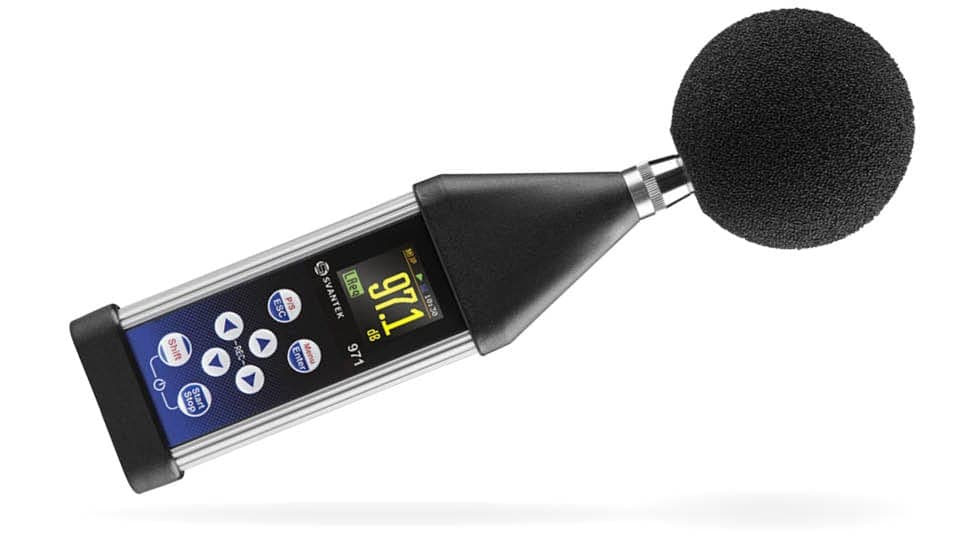
Svantek SV 971A klasse 1 geluidsmeter

Which values does a NEN 5077 measurement produce?

For separating constructions between dwellings, two quantities matter. Airborne sound: the characteristic airborne sound level difference DnT,A,k, expressed in dB; higher is better; the new-build requirement from the BBL is greater than or equal to 52 dB; the source is a dodecahedron loudspeaker in the source room. Impact sound: the weighted standardised impact sound level LnT,A, expressed in dB; lower is better; the new-build requirement from the BBL is less than or equal to 54 dB; the source is a standardised tapping machine on the floor above. Note the direction of the two scales: with DnT,A,k, 55 dB is better than 52 dB, while with LnT,A, 50 dB is better than 54 dB. In reports you will often see DnT,A,k abbreviated as DnT,A.

DnT,A,k indicates how many decibels the separating construction removes from sound that travels through the air, such as voices, television and music. LnT,A indicates how much sound remains in the receiving room from a standardised impact on the floor, such as footsteps or a chair being moved. These are two separate measurements, each calling for its own remedies: mass and airtightness are effective against airborne sound, decoupling against impact sound. See our pages on wall insulation and floor insulation.

NEN 5077 and the Building Decree

The Building Decree sets the requirements; NEN 5077 describes how you test against them. Since the Omgevingswet, the Dutch Environment and Planning Act, came into force on 1 January 2024, the BBL has been the successor to the Bouwbesluit 2012, the previous Building Decree. For determining airborne and impact sound insulation, the BBL designates NEN 5077 as the measurement method. Anyone who has to demonstrate compliance, whether to the municipality or in a legal procedure, therefore cannot avoid a measurement compliant with this standard.

Between two newly built dwellings the requirement is DnT,A,k greater than or equal to 52 dB and LnT,A less than or equal to 54 dB. For conversion into rooms and the splitting of dwellings, municipalities often apply that new-build requirement in full, without any option to deviate. For the façade the BBL works with an indoor value: a maximum of 33 dB from traffic noise applies in habitable rooms, and that value is also determined with NEN 5077. You can read more about this on.

NEN 1070: from class K=1 to K=5

Alongside the statutory minimum from the BBL there is NEN 1070, a standard that expresses sound insulation in quality classes. Class 3 coincides with the legal minimum for new construction, and the classes rise in steps of 5 dB. Class 1, excellent: airborne sound 62 dB or higher, impact sound 44 dB or lower, you do not hear the neighbours. Class 2, good: airborne sound 57 dB or higher, impact sound 49 dB or lower, only loud activities are slightly audible. Class 3, moderate: airborne sound 52 dB or higher, impact sound 54 dB or lower, the legal minimum for new construction, where 10 to 25 per cent of residents experience nuisance. Class 4, inadequate: airborne sound 47 dB or higher, impact sound 59 dB or lower, the level of existing buildings, where the neighbours are regularly audible. Class 5, poor: airborne sound below 47 dB, impact sound above 59 dB, you hear practically everything. This is an indicative summary based on NEN 1070:1999.

Those classes are useful because the law only sets a minimum. A dwelling that exactly meets the BBL is not quiet; it is just acceptable. If you want to record which level of comfort you are aiming for in a purchase contract, a renovation brief or a homeowners' association resolution, a class agreement is more concrete than a statement that something is well insulated. In every report we state the measured value and the corresponding class compliant with NEN 1070. See also our approach for. Note the connection with existing buildings: class 4 is precisely the combination of 47 dB airborne sound and 59 dB impact sound that applies as the lower limit for existing dwellings. We look separately at what that means for the sound insulation of walls between two dwellings.

NEN 1070NEN 1070:1999BBL

New-build requirements versus practice in existing buildings

The new-build requirements apply to what you build now or renovate substantially. A dwelling from 1900 does not have to meet them: for existing buildings the regulations set lower limits, where, for impact sound, LnT,A less than or equal to 59 dB is often applied as the lawfully obtained level. That difference explains why a measurement in an old building can come out well above the new-build value without any formal breach.

In pre-war buildings with timber joist floors we regularly measure impact sound levels of LnT,A 65 to 75 dB, against 54 dB for new construction. For a dispute that difference is decisive: you then know whether the issue you are raising is a statutory exceedance or a comfort problem that you have to resolve through the homeowners' association or the landlord, or between yourselves. Those two routes call for a different approach, and the measurement report is what substantiates the distinction. See.

How a NEN 5077 measurement works in practice

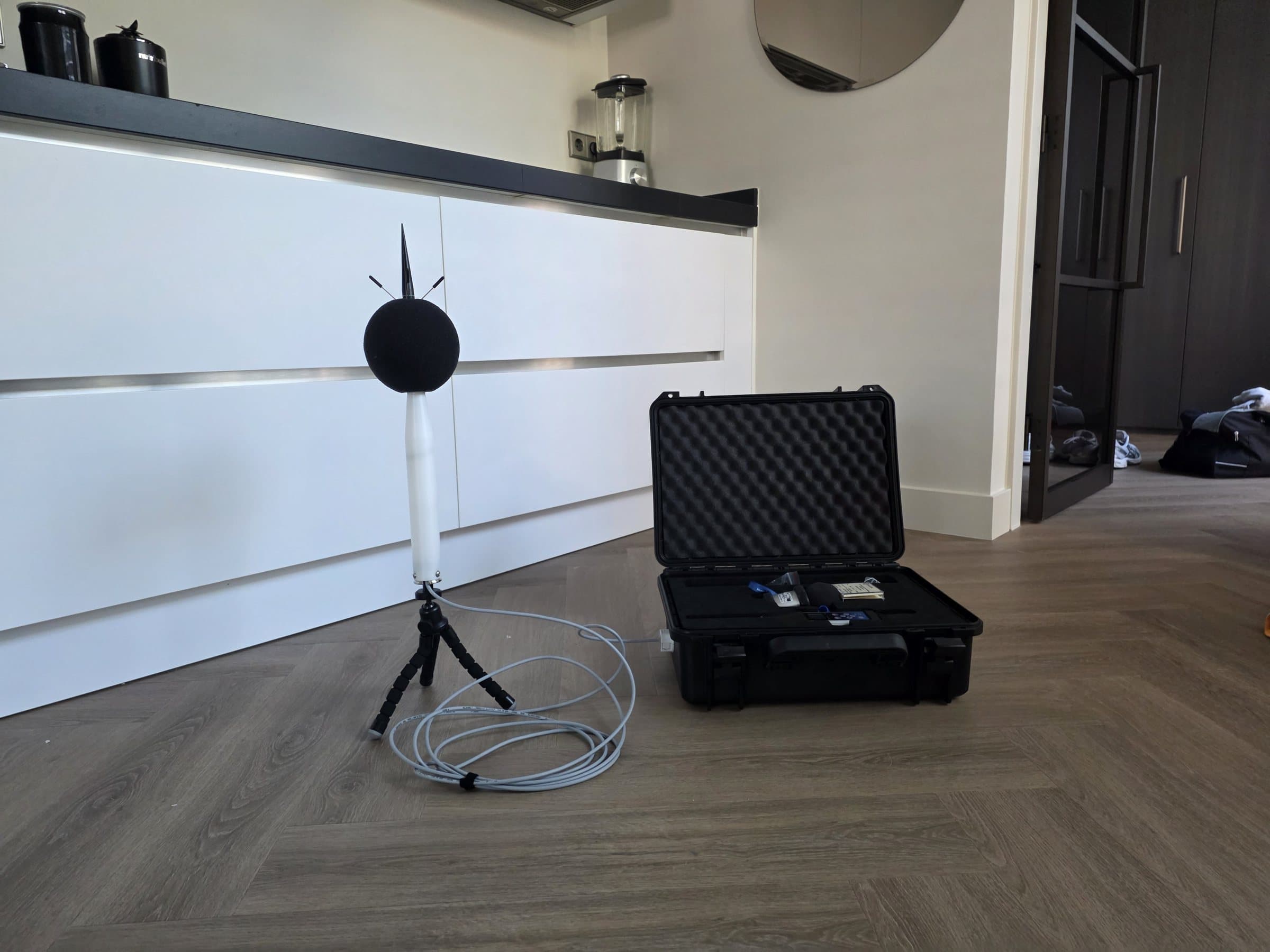
We measure on site, in two rooms at the same time. For airborne sound we place a dodecahedron loudspeaker, which produces a standardised sound spectrum, at several positions in the source room, and we measure the level in the receiving room with a Class 1 sound level meter in 1/3 octave bands. For impact sound we place a standardised tapping machine on the floor of the room above. We also measure the reverberation time and the background level, because both are needed to correct the result. The measurements themselves follow NEN-EN-ISO 16283-1 and NEN-EN-ISO 16283-2; NEN 5077 determines how you derive the final value from them.

A phone app will not get you there. Such an app lacks a calibrated Class 1 microphone, does not measure in 1/3 octave bands and does not correct for reverberation time and background noise. Something else matters even more: without a standardised sound source in the source room you measure whatever the neighbours happen to be doing, and not what the construction lets through. An app measurement is therefore not reproducible and carries no evidential value before the rental commission, the homeowners' association or the court. See.

When do you need a NEN 5077 measurement?

Four situations occur most often. A dispute with the neighbours or within the homeowners' association, where you want to know whether the separating construction meets the standard. The handover of new construction or a renovated apartment, where the contractor has to demonstrate that what was agreed has been delivered. Proceedings before the rental commission or the court, where a measured value carries more weight than a statement about nuisance. And a permit application for conversion into rooms or splitting, where the municipality requires an acoustic report.

With us, a noise measurement compliant with NEN 5077, covering impact sound and airborne sound, costs from 1,998 euros excluding VAT. Exactly what you pay depends on the number of room combinations and the complexity of the situation. KGI Groep has been measuring since 1994 and has delivered more than 10,000 reports. We do not sell insulation materials and do not carry out work ourselves, so there is no commercial interest behind our measurement report or our advice.
from € 1.998 excl. VAT

The exact price depends on the number of room combinations and the complexity of the situation.

Many Dutch legal expenses insurers reimburse the cost in full or in part.

Request a quote for your situation

Frequently asked questions

What is NEN 5077?

NEN 5077 is the Dutch standard Geluidwering in gebouwen, which translates as sound insulation in buildings. The standard describes how you determine the sound insulation of the façade, the airborne and impact sound insulation between rooms, the noise from building services and the reverberation time. It lays down the measurement method: which source, which measurement positions and which corrections you use. The limit values themselves are not in NEN 5077 but in the Building Decree (BBL).

Which requirements does NEN 5077 set for sound insulation?

NEN 5077 sets no requirements itself; it only describes how you measure. The requirements are in the Building Decree. Between two newly built dwellings an airborne sound level difference DnT,A,k of 52 dB or more and an impact sound level LnT,A of 54 dB or less apply. For existing buildings lower limits apply, where, for impact sound, LnT,A 59 dB is often used.

What do DnT,A,k and LnT,A mean?

DnT,A,k is the characteristic airborne sound level difference: how many decibels the separating construction removes from voices, television or music. The higher, the better. LnT,A is the weighted standardised impact sound level: how much sound remains in the room below from a standardised impact on the floor, such as footsteps. The lower, the better. The two scales therefore run in opposite directions, which often causes confusion when reading a report.

What does a noise measurement compliant with NEN 5077 cost?

A noise measurement compliant with NEN 5077, in which we measure both impact sound and airborne sound, costs from 1,998 euros excluding VAT. The final price depends on the number of room combinations and the complexity of the situation. You receive a report with the measured values, the test against the BBL, the class compliant with NEN 1070 and advice on improvement. Call +31 (0)20 808 70 90 for a quote.

Can I do a NEN 5077 measurement myself with an app?

No. A phone app lacks a calibrated Class 1 microphone, does not measure in 1/3 octave bands and does not correct for reverberation time and background noise. A NEN 5077 measurement also requires a standardised sound source in the source room, such as a dodecahedron loudspeaker or a standardised tapping machine. Without that source you measure whatever the neighbours happen to be doing instead of what the construction lets through, and that yields no usable evidence.

What is the difference between NEN 5077 and NEN-EN-ISO 16283?

NEN-EN-ISO 16283 describes the measurement itself in the field: how you set up the loudspeaker and the tapping machine, how many positions you use and how you measure. NEN 5077 is the Dutch standard that goes a step further and determines how, from those measurements, you derive the quantities against which the Building Decree tests, such as DnT,A,k and LnT,A. In practice we use both standards alongside each other.

Does NEN 5077 also apply to existing dwellings?

Yes, the measurement method is the same. What differs is the requirement you test against. Existing buildings do not have to meet the new-build values; lower limits apply there, with LnT,A 59 dB often taken as the lawfully obtained level for impact sound. In pre-war buildings with timber floors we regularly measure 65 to 75 dB. A measurement shows whether the issue you are raising is an exceedance or a comfort problem.

Consultation or direct quote

Schedule a free consultation or request a direct quote via the form. We respond within one business day.

+31 (0)20 808 70 90
info@kgigroep.nl
Keizersgracht 241
1016 EA Amsterdam